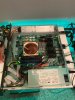
1U Supermicro Server 6x 10GBE RJ45 X10SLH-LN6TF LGA 1150 H3 X10SLH-N6-ST031

Notice: Page may contain affiliate links for which we may earn a small commission through services like Amazon Affiliates or Skimlinks.
I can't make it boot from USB3 with my Zalman VE350 HDD/DVD emulator: Windows images do not even start to boot, Linux distributions give a console full of dev/fs/io errors. No problems with USB2.

For me this link does not work if I open it from the forum, but when I copy and paste it manually in the new tab it works. Seems like the website does not like referer header.
@zedalert , that works, thank you:) re: "copy and paste it manually in the new tab it works".
 
  • Like
Reactions: abq and zedalert
BE768B1B-60EA-44B3-B811-567AF64B0D14.jpeg
Registered just off this thread, great community here, have a build in progress used a lot of the information here to get up and running. It’s functional, gotta make a top for it though, it’s part of a bigger themed project so you’ll have to excuse some oddities for looks

planning a right up once it’s a bit more complete, quite the learning experience
 
I used a video card companion fan to provide heat dissipation for X540, and i350-T6 was used for pcie X8 interface. So far, it seems to work well. Ordinary desktop chassis can also accommodate this motherboard, which costs about 20 DOLLARS
 
I used a video card companion fan to provide heat dissipation for X540, and i350-T6 was used for pcie X8 interface.
I have a similar card with 6 gig ports, Silicom brand i350-am2 as well as a dell brand i350-t4 for 10 gig ports total. I thought it would be a cheap solution to use as a switch. I have discovered that both of my nic's are fake intels, dispite my through investigation and passing all the normal checks, large heatsinks, embossed delta transformers, txc crystal, correct smt parts and part numbers/dates. The only way I found out they were fake was calling intel, I had a issue with one of them but it turned out to be transient, and since I had them on the phone I checked both of them out and was told they were both fake, although high end. I did dig out a useful bit of info when I asked about the stickers, EVERY official Intel NIC will have a BradyID or Yottamark sticker weither it comes from an OEM or direct, so keep that in mind and always ask before purchase to verify.
 
Last edited:
anyone know what the current/latest bios is on this bad boy? I just picked one up off ebay for an opnsense router.
 
anyone know what the current/latest bios is on this bad boy? I just picked one up off ebay for an opnsense router.
There's really just a single working one. You can search my posts for it.
 
Hi,
I am trying to set up OpnSense on one of this puppies to do vlan routing.
I am seeing > 9 Gbps when receiving on the device (iperf3 -c on opnsense) but can only get about 1.5 Gbps when sending from it. Thats already with offloading enabled. Vlans are used on the interfaces.
Anybody know how to fix the slow TX ? Didn't try Linux yet
 
  • Like
Reactions: Churchill
Hi,
I am trying to set up OpnSense on one of this puppies to do vlan routing.
I am seeing > 9 Gbps when receiving on the device (iperf3 -c on opnsense) but can only get about 1.5 Gbps when sending from it. Thats already with offloading enabled. Vlans are used on the interfaces.
Anybody know how to fix the slow TX ? Didn't try Linux yet

did you post on the Opnsense forums? There's someone else with the same issue you are having and I'm curious as well as I'll be building the same thing you are building on these guys.
 
did you post on the Opnsense forums? There's someone else with the same issue you are having and I'm curious as well as I'll be building the same thing you are building on these guys.
no I didnt, can you post the link?
Btw I am using Mikrotik SFP+ 10GBase-T modules and the Mikrotik 16 port sfp+ switch. Those modules and the supermicro boards are the only 10GBase-T hardware I have. I have other SFP+ hardware though which I could test.
 
I don't think it's related. It is totally different hardware.

I tested with Arch Linux (kernel 5.17) and was able to get >9Gbps in both directions. So it's definitely something with OpnSense and not the hardware

Wasn't sure if it was the driver or not. I'm disappointed that you aren't getting 10gbps bandwidth on that hardware.

Can you try pfsense and see if you get the same problem?
 
I'm disappointed that you aren't getting 10gbps bandwidth on that hardware.
Unfortunately I have yet to see a pfsense/opnsense system without NIC performance or compatibility issues. Xen VMs needed tweaks and can't do VLANS (need to make one interface per vm as a workaround). APU2 not only suffers from BSD single thread limitation but I also couldn't replicate the performance claims after tweaking. Plus I had the weirdest issues with PPoE WAN using pfsense/opnsense on an APU2.

Feature wise opnsense is really great but to me it looks like the praise for the BSD networking stack doesn't live up to the "it just works" state of Linux :confused:.

Can you try pfsense and see if you get the same problem?
Can as a test but wouldn't run that myself. I am trying to migrate away from it (currently running in VM) as development has really stalled.
 
Unfortunately I have yet to see a pfsense/opnsense system without NIC performance or compatibility issues. Xen VMs needed tweaks and can't do VLANS (need to make one interface per vm as a workaround). APU2 not only suffers from BSD single thread limitation but I also couldn't replicate the performance claims after tweaking. Plus I had the weirdest issues with PPoE WAN using pfsense/opnsense on an APU2.

Feature wise opnsense is really great but to me it looks like the praise for the BSD networking stack doesn't live up to the "it just works" state of Linux :confused:.


Can as a test but wouldn't run that myself. I am trying to migrate away from it (currently running in VM) as development has really stalled.

I want to move away from pfsense myself but if we can say that pfsense gives you 10gbps and opnsense does not then we can go back to the opnsense folks with some solid things to fix.
 
I want to move away from pfsense myself but if we can say that pfsense gives you 10gbps and opnsense does not then we can go back to the opnsense folks with some solid things to fix.
I checked with pfSense and I am getting 5.5Gbps (iperf3 -s on pfsense, with -P2 it reaches >9Gbps) and > 9Gbps in reverse direction.

Goto the networking forum and ask that question. Enjoy the answers.
I personally wish for OpenWrt kernel and drivers with OPNsense Ui and features.

Edit:
Just tested with OpenWrt. It can basically do full speed 10Gbps across the firewall (default rules) using vlans on wan and lan
 
Last edited: