
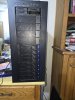
I am brand new to the forum, so I figured I would introduce myself by showing one of my projects.
Comments, Compliments and critisisms are welcome.
Like most good homelab projects, Moribus wasn't really planned. It evolved.
Moribus originally started life as a Dell PowerEdge T610 running Unraid. For years it handled media storage and general server duties without complaint, but eventually I ran into two problems: I was out of drive bays, and I had accidentally acquired a small mountain of enterprise hard drives.
A local company was closing its doors and liquidating equipment. I managed to pick up a JBOD enclosure loaded with SAS drives. While that solved the storage shortage, it introduced a new issue. The enclosure sounded like a jet engine, and I didn't have a suitable place to run it without driving everyone in the house crazy.
The T610 was also reaching the limits of how much storage I could reasonably cram into it, so instead of trying to force the old platform to do more, I decided to build a dedicated storage server designed around drive density and future expansion.
Over the next year or so, Moribus slowly came together.
================================
UNRAID HARDWARE
================================
Board : B550M DS3H AC R2
BIOS : F3
CPU : AMD Ryzen 5 5500
C/T : 6C / 12T
RAM : 15Gi
Drives:
12x 5.5T ST6000NM0024-1HT17Z
1x 14.6G Cruzer Fit
1x 931.5G CT1000P510SSD5
1x 223.6G R3SL240G
PCIe:
GPU : Intel Arc A310
HBA : LSI SAS3008
NIC : RTL8125 2.5GbE
WiFi : RTL8821CE
NIC : RTL8111 GbE
The Chassis
The server is housed in a Rosewill Thor NAS Pro.
The case originally came with two Rosewill hot-swap drive cages, each occupying three 5.25-inch bays and holding four 3.5-inch drives. To increase capacity, I added a third matching cage, giving me a total of 12 hot-swap drive bays without needing any external storage chassis.
I also installed a 4-bay 2.5-inch drive cage in another 5.25-inch bay for SSD storage and future expansion.
The result is a storage-focused tower that provides enterprise-level drive capacity while remaining much quieter and easier to manage than the old JBOD enclosure.
Storage
The heart of the system is a collection of twelve enterprise Seagate SAS drives connected through an LSI SAS3008 HBA. Combined with SSD storage for cache and application data, the system provides plenty of space for media, backups, Docker volumes, and whatever future projects appear.
One of the primary goals of this build was simplicity. Standard components, good airflow, hot-swappable storage, and room to grow without needing external shelves or proprietary hardware.
Why the Arc A310?
The Intel Arc A310 is probably the most unusual component in the build.
Since the Ryzen 5 5500 lacks integrated graphics, the system requires a discrete GPU simply to provide video output during POST, BIOS configuration, troubleshooting, and maintenance. The A310 happened to be available as a spare card, consumes very little power, and fills that role perfectly.
At the moment it serves primarily as the system's display adapter rather than as a dedicated Plex transcoding device. It is simply a reliable, low-power GPU that allows the system to boot and provides a local console when needed.
Plex and Beyond
Moribus was originally built to be a Plex server, and Plex is still its primary responsibility today. Over time, however, it has become much more than a media box.
Like many homelab systems, once the storage and infrastructure were in place, new services kept finding a home on the server.
Today Moribus acts as file server, media server, monitoring platform, logging platform, and general-purpose application host.
Docker Services
Plex Media Server
The primary workload of the server. Hosts and streams the media library to local and remote users.
Tautulli
Provides Plex usage statistics, viewing history, user tracking, and reporting.
SFTPGo
Secure file transfer and file-sharing platform used for remote access and data exchange.
Nginx Proxy Manager
Handles reverse proxying and SSL certificate management for services exposed to the internet.
DuckDNS
Maintains dynamic DNS records, ensuring external services remain reachable when the ISP changes the public IP address.
Prometheus
Collects metrics from services and infrastructure across the homelab.
Grafana
Provides dashboards and visualizations for monitoring server performance and health.
Loki
Stores and indexes logs from applications and services.
Promtail
Collects logs from systems and containers and forwards them to Loki for centralized analysis.
Current Status
What began as a replacement for an aging Dell T610 has become the central platform of my homelab. It now provides over 60TB of raw spinning-disk storage, hosts a growing collection of Docker services, and still has room for additional SSDs and future expansion.
Of course, no homelab project is ever really finished.
For now, Moribus has finally solved the storage problem that started this entire journey.
At least until another closing company offers me a pile of hard drives.
Attachments
-
 185.5 KB Views: 13