NVIDIA DGX Spark 64GB Launched and Big 128GB GB10 Price Increases

  • Thread starter Thread starter John Lee
  • Start date Start date
Notice: Page may contain affiliate links for which we may earn a small commission through services like Amazon Affiliates or Skimlinks.
Neither the Mac nor AMD has a scale out option, so the Nvidia does give some optionality there. Be interesting if they add options for this in teh next generations. Yes people are using thunderbolt on Mac (and on AMD I think but its slow there), but its not the same as 200Gb.
 
Strix/Gorgon Halo can scale out at 10G. [Edit: This is a solution. I do not mean that this is a good scale out solution…]

The newer MacStudio reportedly can scale out over Thunderbolt 5 at 80 Gb/s. Not the same as 200 Gb/s, but I suspect that Apple will make 80Gb/s RDMA "just work" out of the box without fiddling with splitting and remixing multiple ports/PCIe roots as GB10 requires to achieve 200 Gb/s—and without additional hardware costs for "regular" Mac users who have no use for data centre NICs at over 100 Gb/s on their photo/video workstation.
According to STH, AI users should scale up before they scale out, so the >128 GB RAM MacStudio may have a point over a cluster of Sparks.
Honestly, though, I'd prefer if it were not the case and desktop users would not have to compete for their gear against the crazy money that is going towards AI.
 
Last edited:
Yeah the 80Gb RDMA should be pretty good latency in theory, and for small clusters people don't want to buy a switch anyway, so its not bad. 10Gb though is pretty poor, 5x latency of the 50Gb signalling rate for 200Gb on the Spark, and no RDMA either.
 
I feel out of touch with reality with all the ai stuff. We have at work quite capable systems with h200 gpus and some of the newest "best"/biggest open weight models and still the output related to software development was just "good" in best cases. I'm trying to understand what people do (besides generating penguins riding bikes pictures) with systems like the dgx spark and for these prices...
 
  • Like
Reactions: TRACKER
My understanding of the "serious" answer is that since these DGX Spark use similar nVidia hardware to your big H200 servers, they can be used for (human!) development and prototyping, including some clustering part, of workloads to be run on the "big iron" when ready for deployment.

Of course, there is the less serious answer that can be used as self-standing AI devices "on the edge" (mandatory buzzwork) to generate priceless pictures of bike-riding penguins. Don't look too hard for rationality in a bubble.
 
  • Like
Reactions: i386
...did memory pricing jump almost 40% in the span of a year? Because this just made a marginally useful expensive piece of kit now just more ridiculously expensive. Yeah, I really have to ask if nVidia has a warehouse full of DGX Sparks just sitting around creating artificial scarcity.
 
  • Like
Reactions: MBastian
Yea. I actually have an idea for an article about how running homelabs should target DDR4 for the next 15-18 months at minimum.

Here is another way to look at it, @WANg: In October 2025, when these came out, we were still jazzed about GPT-OSS-120B as being a somewhat useful model. Agentic and new models have really changed the game. Qwen3.6-35B-A3B is an awesome babysitter for test machines. We can have scripts run, and an agent backed by that (fast) model can do first- and second-level triage if something goes wrong, such as when we hit a script corner case on new hardware.

That does not change that we are hiring locally. It does, however, change the skill set of the folks I need to hire.

Another way to look at it is that they are much more useful now than a year ago. So as AI gets better, it drives up memory prices but also increases utility. That is why I am excited for next-gen models and agents, but also why I think DDR4 is right for the legacy homelab tasks.

Hmmm...the issue with DDR4 is that of density, and the kind of hardware that you can hang off it, and how much power efficiency bang-for-buck you can get out of it. With AMD it's anything Epyc Milan/Rome/Naples, with Intel it's anything older than Sapphire Rapids. They are all getting on quite a bit. One of the beige whales that I had in my wishlist (much like the VEP4600) was a Dell PowerEdge XR4000z (the pedestal mountable one) along with a single 4510c sled that has a Xeon D 2700 series chip inside, about as many LRDIMMs that I can beg borrow or steal (4 slots of LRDIMMs, 512GB in total), and then maybe hang a pair of PCIe-to-Oculink breakouts off the PCIe expansion sled (so I can wire up / turn off eGPUs when not needed).

The biggest issue...? My Minisforum N5 Air has the Oculink and the PCIe breakout allowing me to hang 2 eGPUs off it, it takes rust spinners for non-mission critical storage, and it went for 500 USD (if you have DDR5 SODIMMs you can repurpose along with a bunch of rust spinners, it's worth it). The PowerEdge XR4000z is NVMe M2 only and the compute sled alone goes for 500+, so I’ll still need that chassis. I'll still have to hunt down LPDIMM or RDIMMs for it, and I am looking for NVMe drives during a time when they themselves are getting a bit pricey. But then I can just NFS export a bunch of zpools off an Atom NAS somewhere and keep the boot drive small...so it’s workable. It’s just that the chassis isn’t designed to run all that quietly.

Then of course, there's the "what the hell am I doing” angle. The N5 Air has a Ryzen 5 255H, which already beat a fairly high end Ice Lake-D and is much more efficient at it, and it has a Radeon iGPU which can run some small LLMs at a reasonable power efficiency. If you want to use that poweredge for AI stuff you’ll still need to connect a GPU in somehow. It would be interesting to see how dense DDR4 LRDIMMs (128GB units quoting for 950 or so) perform versus DDR5 and whether they are worth keeping around…of course a pair of 64GB DDR5-5600 SODIMMs are quoting at 1600+ and maxes the N5 Air out, while the Poweredge can take 4 LRDIMMs all the way to 512…

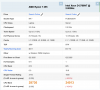
Screenshot 2026-10-05 at 9.27.28 PM.png
 
Last edited:
Seriously, I have 3x $200 Claude accounts, I still need a ton of more tokens. Running these would absolutely be helpful, but I am actually looking at the DGX workstation instead. Its expensive, but still cheaper than another employee and can accellerate the whole organization.

Got you today :-)
 
Saw it! Great video! That machine is a beast!

Seriously 200k tokens/s is just insane. But it really doesnt matter, if Opus 5.5. can deliver better results more quickly. I feel like these numbers are not measuring intelligence per second. But this is a problem with all model benchmarks today.

I think a proper plan, with a detailed specification can be the best way to test a models intelligence. And it should be a secret that they cant train on.

Yeah, I think that’s the first question I would ask - if I am spending x amount of money to produce y, there should be some kind of quantifiable metric that would allow me to justify the spend, and it should not be something that sounds like “magic beans”.

Let’s put it this way…I built my home AI box based on 18 month old RAM, a NAS enclosure that I didn’t quite need, a bunch of SATA drives liberated from a SAN that I tossed away, and a datacenter GPU that I technically was not supposed to have but was fortunate enough to buy right before the price jumped up, and I recently made the mistake of telling the missus about how much tokens it can generate on Qwen 3.8 and how little money i spent on it.

“this is the same setup that took 15 minutes to tell you something was wrong, and then you spent the next 2 hours trying to figure out why it was wrong. You are still not sure what you have to do to make it right, and ended up spinning up 2 other things in an attempt to correct it?”

“Yes”

“…Did you fix it?”

“No. But i am using the Corporate Claude account to analyze the situation…”

“…and this is something factual that can be easily looked up on a quick 5 second google search…”

Well, it’s not power-efficient for solving issues, but it sure is….fun?
 
  • Like
Reactions: miraculix